
Crisis tabletop exercises

Practise your crisis response in a simulation, before a real crisis tests it.

An Authentik Tabletop is a crisis exercise built around your organization and run by an expert facilitator. Your team responds to a realistic scenario as it unfolds, then gets a debrief and a short, practical plan to close the gaps it found.

Authentik Tabletops in two minutes

The video uses a fictional company. Your exercise is built around your own organization.

Read what the video shows

About two minutes, with music and no narration. The only speech is a short phone call, captioned on screen and written out in item 5.

  1. The first time your leadership team responds to a crisis together shouldn’t be a real crisis with real stakes.
  2. Crisis Tabletop Simulations. A live crisis exercise, customized for your organization. Not a slide deck, and not a script. Real-world skills. Real-world uncertainty.
  3. We build a custom scenario around your business, one your team could actually face. Your real work locations. Your real roles. Your real risks. On screen: a map of Northfield Distribution, a fictional example, with two warehouses, a head office, the fleet, a loading yard, Highway 3, an east access road, a muster point in the north lot and a fire front. An alert reads: “Wildfire evacuation alert. 300 staff on shift. Customers expecting orders by noon.”
  4. Before the day, we pre-assess your team’s crisis leadership skills. Strengths become advantages in the simulation. Gaps become pressure points. On screen: character cards for four fictional leaders: Dana Okafor, Chief Executive Officer; Priya Shah, Chief Operating Officer; Marcus Reid, VP Communications; and Sara Leduc, VP People & Culture. Each card scores skills such as Logistics, Composure, Connector and Rapport, for example Rapport +5. Skills at +0 are tagged as pressure points.
  5. The phone rings. The characters don’t just call. They talk back. A real two-way conversation, live. On screen: an incoming call from Ridgeline Regional Fire, Incident Command, answered on speaker and captioned. Ridgeline Regional Fire: “This is Ridgeline Regional Fire. We need you to evacuate your site immediately and push an emergency alert out to your employees.” Priya, COO: “Understood. Where do you want our people to go?” Ridgeline Regional Fire: “North lot first, then out on Highway 3. You’ve got twenty minutes.” Then: Characters scale the challenge to your team.
  6. Under pressure, information arrives in pieces, just like real life. Decisions shift the simulation in real time. On screen: a message, “Highway 3 traffic is backing up westbound”; a call from Valley News, “Are your staff safe?”; an alert, “14 staff haven’t checked in at the muster point”; and a decision, “Which route out?”, between Highway 3 west and the east access road, with under five minutes on the clock.
  7. The dice: making the right call doesn’t guarantee it works. Roll plus your team’s skill, against the difficulty. Your team’s assessed skills tip the odds. Nothing is guaranteed. On screen: “Send the emergency alert”, Logistics +3 against difficulty 12. The roll is 15, plus 3 makes 18: “Alert out. Staff heading to the north lot.”
  8. Plan A: move everyone out via Highway 3. Composure +4 against difficulty 14. Then an update: “Fire has jumped Highway 3. The road is closed. Your convoy is turning around.” Just like real life, your team has to think on its feet when the first plan doesn’t work. Plan B. Fast.
  9. Plan B: the east access road. Connector +2 against difficulty 13. “Everyone out by 11:40 a.m.”
  10. All of this runs live on our own simulation platform. The map, the calls, the decisions and the dice, on the laptops and phones your team already carries. On screen: the same example on the platform, with the clock at 10:52, the Highway 3 traffic message, the captioned fire call, a decision with 4:12 left and the Plan B roll, 16 plus 2 makes 18: “Everyone out by…”
  11. An immersive experience, online or in person, facilitated by an expert. On screen: Craig Whitton, M.Sc., Risk, Crisis and Disaster Management, with 20 years of experience responding to crises and leading teams through emergencies. In person. Online.
  12. The debrief is where we deliver the most value. We find the gaps, identify where to sharpen processes, and bring our crisis leadership experience to next steps for you and your team. On screen: an after-action briefing for the example’s leadership team, with three priority fixes, each with an owner and a deadline: name one incident commander, known to every team (executive team, 14 days); pre-plan two evacuation routes for every site (operations, 30 days); match the staff alert list to who’s actually on shift (people and culture, 30 days). A strength to build on: the emergency alert went out within minutes of the first call.
  13. What your team gets to practise. Decisions under pressure. Clean escalation and handoffs. Speaking with one voice. Coordinating across teams. Recovering when plans fail. So when it’s real, your team isn’t doing it for the first time.
  14. “It illuminated how information travels through our office. It also showed me how much each person in the office is pulled in, depending on the situation.” A tabletop participant. Then: Over 1,400 people. Consistent results. 9 out of 10 found our consultants engaging, 9 out of 10 would recommend Authentik, and 9 out of 10 said the objective was achieved. Participant assessments across every Authentik service since 2018.
  15. Let us help your leadership team practise its hardest hour, so the real one is a lot less hard. Authentik Consulting and Training. Book a 30-minute scoping call at authentikconsulting.ca.

The “9 out of 10” figures come from Authentik’s published assessment summary, May 2018 to October 2025, which reports 98.5% positive for engaging delivery,93.2% for willingness to recommend Authentik and91.3% for achievement of objectives. These are participant evaluations collected at the end of each session, not measured outcomes. The count and the date are there so you can weigh them.Read the summary (PDF).

How the Simulation Works

A traditional tabletop is a discussion around a slide deck. Ours is a simulation that unfolds as your team decides, which puts them under the kind of pressure a crisis brings. The debrief then turns what happened into changes your team can make.

  • Everyone gets a character sheet.

    A short pre-assessment scores each person’s crisis skills. Strengths become advantages in the simulation, and gaps become pressure points.

  • The phone rings.

    Characters such as a fire chief or a reporter call your team mid-exercise, and they talk back. News and setbacks arrive in pieces.

  • Dice add the luck no plan controls.

    Your team rolls, adds its skill and tries to beat the difficulty. Military planning exercises use dice for the same reason: a good decision can still go wrong, so your team practises what to do when the first plan fails.

  • Your facilitator can stop the clock.

    We pause at key moments so people can explain their decisions and hear how others would handle them.

“It illuminated how information travels through our office. It also showed me how much each person in the office is pulled in, depending on the situation.”

A tabletop participant

When to Book a Tabletop

  • Your crisis plan has never been tested under pressure.
  • Your leadership team is new, or has never handled a crisis together.
  • You’ve had a near miss, or watched a similar organization go through a crisis.
  • Your board, insurer or auditor wants to know how ready you are.
  • Executives & Leadership Teams

    Pressure-test decision making, role clarity, and communication. Make sure your leadership team stays aligned when it matters most.

  • People, Risk, & Operations Leaders

    Identify real-world failure points across policy, people, and operations, so you can fix them while you have the gift of time.

  • Frontline Incident Response Teams

    Build confidence through practice. Improve coordination, escalation pathways, and situational awareness across roles.

What You Get

  • A bespoke, tailored scenario: Built around your real-world risks, roles, and operating context.
  • Pre-assessment of critical crisis skills: Teams get advantages in the simulation based on actual skills and abilities.
  • A facilitated tabletop session: High engagement to keep people thinking on their feet throughout the scenario.
  • Realistic injects and decision points: Test responses to escalation and complexity, with the simulation reacting to the choices made.
  • A structured debrief: Create a culture of risk communication with facilitated debriefs.
  • A concise after-action briefing: 1–2 pages you can use to guide iterative improvement.

Tabletops start at $9,500 and are scoped from there.

Capabilities We Test

  • Role Clarity & Decision Rights: Who decides what, and when?
  • Escalation and Handoffs: When does a problem become an incident, and who owns it then?
  • Communications under uncertainty: Public affairs, internal efficacy, and importantly, what to say (and what not to say) when.
  • Coordination across teams: Operations, people managers, comms, leadership, all working as one system.
  • Situational Awareness: What you know, what you don't, and how to fill the gaps quickly.
  • Team strengths in action: A quick skill check shows who’s best at what so the team can play to strengths and coordinate smarter.
  • Recovery Planning: What back to stable actually looks like.
Craig Whitton

Led by Craig Whitton, M.Sc.

Authentik’s tabletops are led by Craig Whitton, who holds an M.Sc. in Risk, Crisis and Disaster Management and has 20 years of experience responding to crises and leading teams through emergencies.

Featured Case Study

See how a large Canadian Post-Secondary relied on Authentik's Crisis Tabletops to prepare for disruption.

A one-day exercise for 14 staff in three teams, after a prolonged campus encampment. People from front-line services, residential life, operations, finance and leadership practised responding to disruption together. Mid-level staff took on leadership roles, and the group reported developing a shared language around risk.

How it Works

Fast to book. Custom to your risks. Built for real-world decision pressure.

  1. 1) Quick Context Call (30 minutes)

    We learn about your environment, your team structure, and what you want to stress-test.

  2. 2) Skill Assessment & Scenario Creation

    Participants do a short pre-assessment (your “character sheet”) so we can design a scenario that fits your team and reveals how strengths combine under pressure.

  3. 3) Live Simulation

    We run the scenario with realistic injects and time pressure. Outcomes reflect both skill and uncertainty, because even great plans don’t always survive contact with reality.

  4. 4) Debrief & After-Action Plan

    You get a thorough debrief, clear strengths and gaps, and a practical plan to close the gaps at a systems level.

AI Plays the Characters. An Expert Runs the Exercise.

AI makes the exercise more engaging. The expertise still comes from Authentik’s facilitators, led by Craig Whitton.
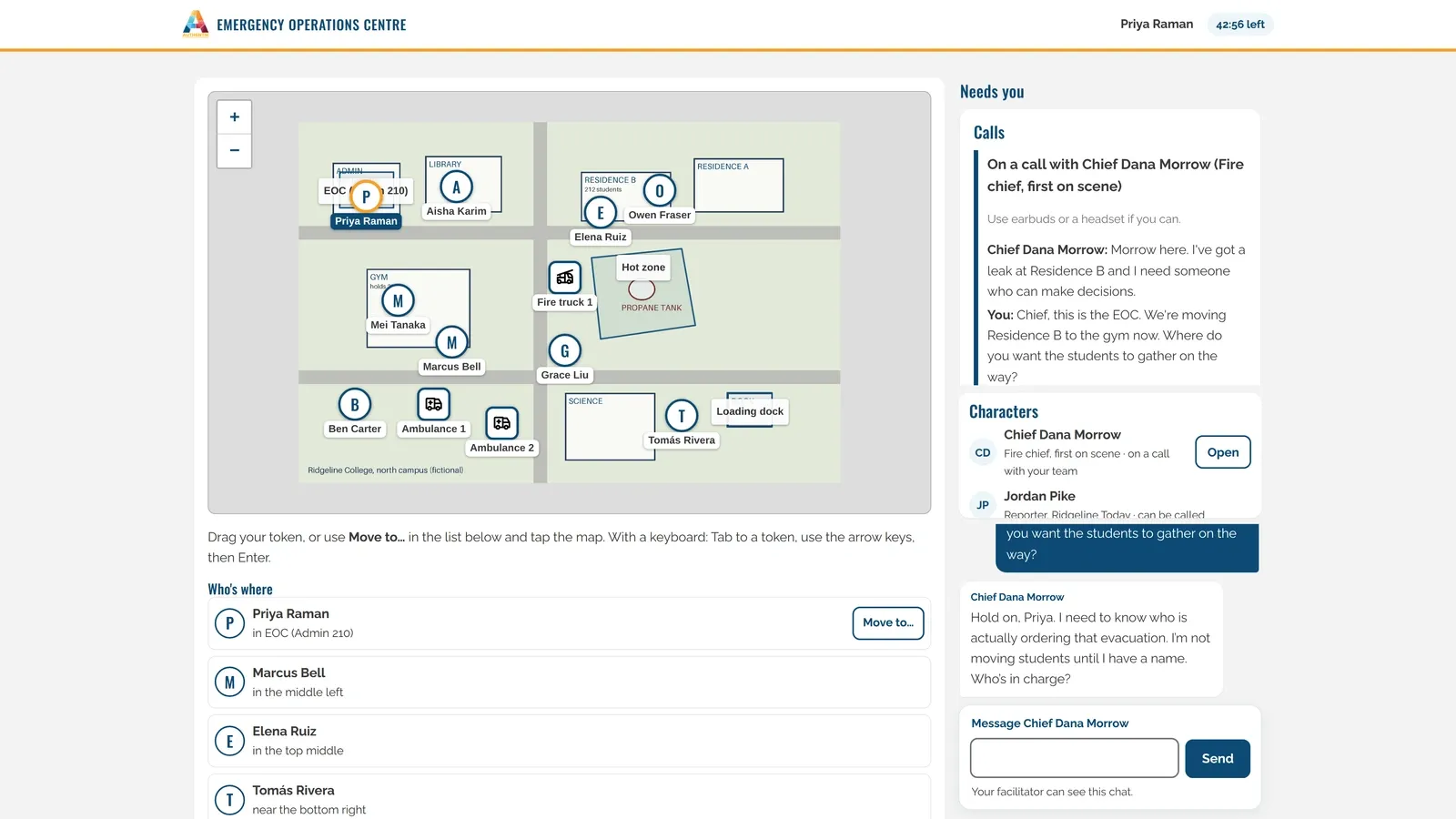
A participant’s screen: a campus map with markers for people and vehicles and a hot zone, beside a captioned call with Chief Dana Morrow, the AI fire chief, and the note “Your facilitator can see this chat.”

What AI Does

  • Plays the fire chief, the reporter and the other characters, and replies in real time by phone or chat.
  • Helps each team draft plans and statements, and flags what it can’t confirm.
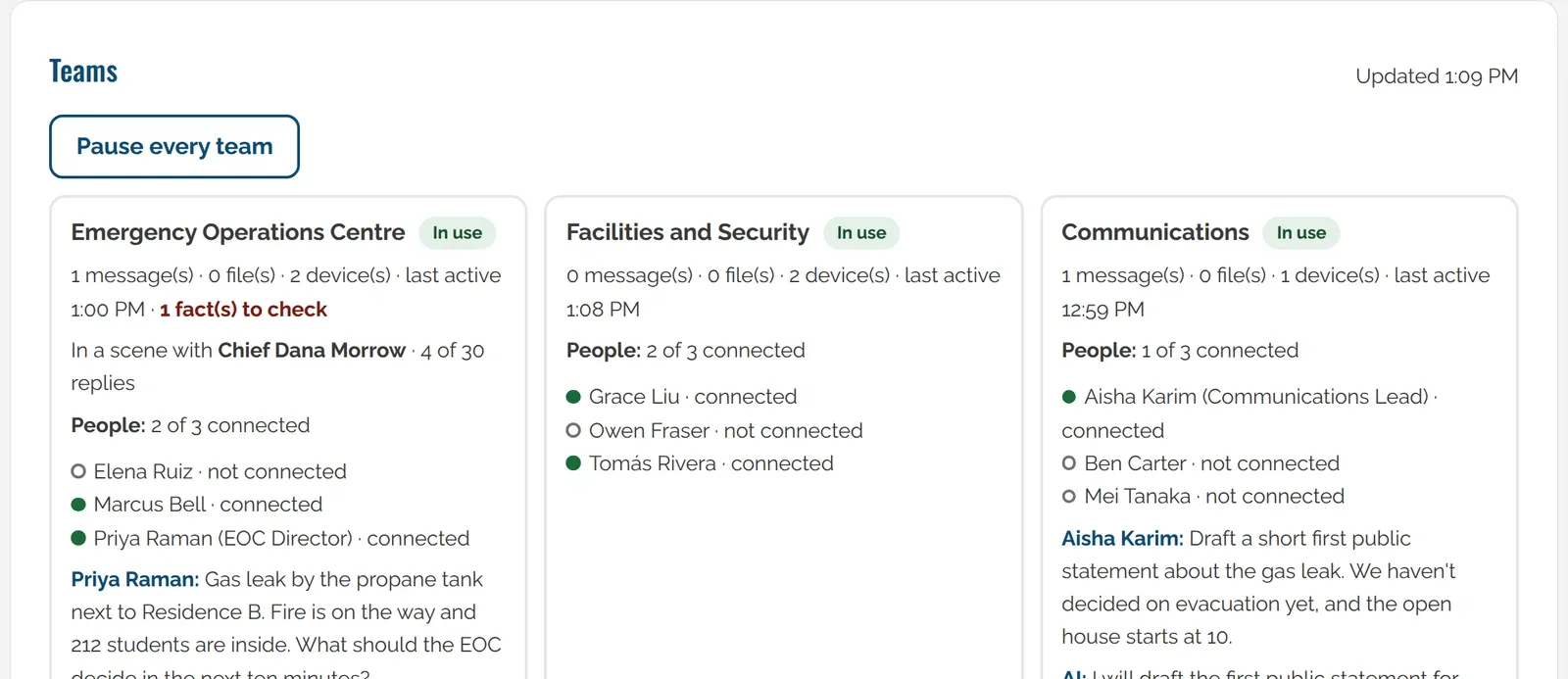
The facilitator’s live view: a Pause every team button above cards for three teams. Each card shows who is connected and their latest messages.

What Your Facilitator Does

  • Designs the scenario around your risks.
  • Follows every team live and can pause the AI.
  • Decides the outcome of every dice roll, then leads the debrief.

Screens from a fictional practice scenario.

People join in a browser on their own phones or laptops, in the room or online. Every call is captioned, and the platform is built to the WCAG 2.2 AA accessibility standard.

Call audio, and any photos used for avatars, are processed on our own equipment in Canada. Some session data may be processed outside Canada by Anthropic’s Claude. We don’t use your data to train AI. Read our AI policy.

Common Questions

Are dice and character sheets serious enough for a leadership team?

Yes. They add pressure and uncertainty. Everything else is about your organization: the scenario, the decisions, the debrief and the after-action briefing.

Will anyone be put on the spot?

The scenario tests roles, decisions and coordination across the team. When we pause or debrief, the focus is on how the team worked together.

Do we need a crisis plan first?

No. If you have one, the exercise tests it. If you don’t, the debrief shows you where to start.

Can you run it online?

Yes. We run tabletops in person or online, and people join on their own phones or laptops either way.

What does a tabletop cost?

Tabletops start at $9,500 and are scoped from there, depending on the size of your group, the length of the exercise and whether it’s in person or online. After the 30-minute call, we’ll send you a quote.

What does our team need to do beforehand?

Book a 30-minute scoping call, then have each participant complete a short pre-assessment. We build the scenario and run the day.

Start With a 30-Minute Call

Let us help your leadership team practise its hardest hour, so the real one is a lot less hard.

We’ll talk through your organization and what you want to test. Tabletops start at $9,500 and are scoped from there. If a tabletop isn’t the right answer, we’ll say so.

Prefer to write first? Send us a message.